
You often see it go by: “The study was successful.”
But if you or someone close to you is living with lung cancer, what you mainly want to know is: what does that mean for us in practice?
In clinical trials, “success” usually does not mean “cure”. It means that researchers have met measurement points agreed in advance: endpoints. These show whether a treatment is safe enough, and whether it does something that matters (for example living longer, or staying stable for longer).
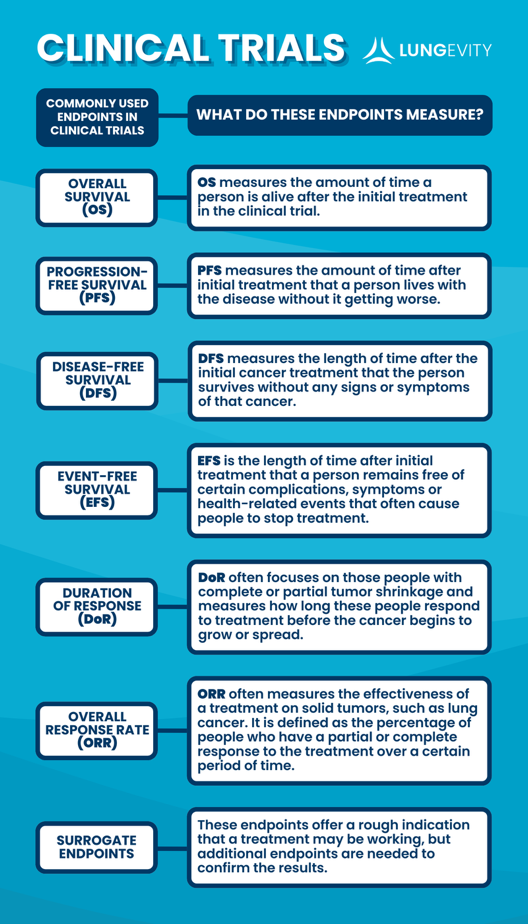
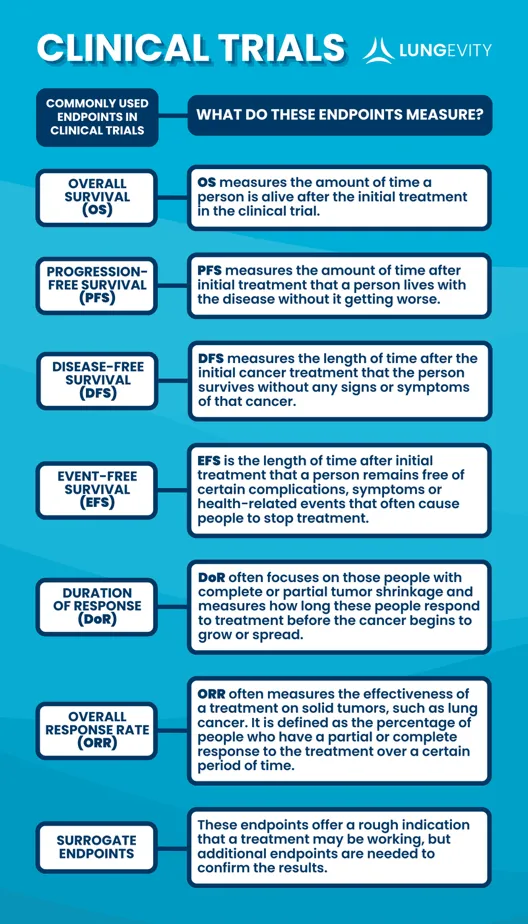
LUNGevity. (2024, 20 August). How We Define Success for a Clinical Trial? Image. https://www.lungevity.org/blogs/how-we-define-success-for-clinical-trial
The main endpoints, simply explained
Overall Survival (OS)
This is the clearest measure: how long people live from the start of treatment in the study. It is very reliable, but it often takes a long time to measure.
Progression-Free Survival (PFS)
PFS measures how long the cancer does not worsen after treatment begins. That result usually arrives sooner than OS, but it does not automatically mean people also live longer.
Disease-Free Survival (DFS)
DFS looks at how long someone shows no signs of cancer after treatment. This is used more often in earlier stages (for example after surgery and follow-up treatment).
Event-Free Survival (EFS)
EFS is similar, but counts a broader range of “events” that change or stop the treatment pathway. It is often used for treatments given before surgery.
Overall Response Rate (ORR) & Duration of Response (DoR)
ORR indicates how many people have a measurable response (the tumour shrinks partly or completely). DoR then covers how long that effect lasts. This is often assessed using standards such as RECIST on scans.
Surrogate endpoints
Studies sometimes use faster signals (such as tumour shrinkage or biomarkers) to find out sooner whether something “works”. Useful early in research, but less solid than OS.
Why this helps you
If you know which endpoint was used, you understand far better what “success” means: is it about living longer, staying stable for longer, or mainly tumour response? That makes news reports less confusing and helps you look more realistically, together with your doctor, at what a treatment might deliver.
7 questions to take to your consultation
For patients and for those close to them (because two pairs of ears hear more):
- What was the primary endpoint of this study?
- Is the study phase 1, 2, 3 or 4 (and what does that mean for certainty and risk)?
- Was the benefit mainly in OS, PFS, ORR…?
- How large was the difference in practice (for example months, percentages)?
- What were the main side effects and how often did they occur?
- Which patient group did the result apply to (type of lung cancer, stage, characteristics)?
- Does this fit my goals (quality of life, gaining time, symptom control, …)?
In closing
A “successful” study is not always the same as “the perfect treatment”. But if you understand what exactly was measured, you stand stronger in conversations, choices and expectations — and that is a form of success too: more of a grip during a difficult period.
(Informational article, not medical advice. Always discuss your situation with your treating team.)