
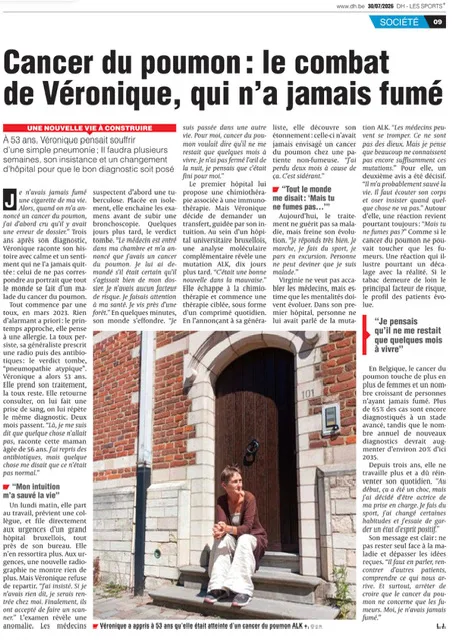
An article in La Dernière Heure highlights an important but still little-known reality: lung cancer also occurs in people who have never smoked.
Veronique, a member of ALK Positive Belgium, was 53 and had never smoked when she was diagnosed with lung cancer. Even so, it took several weeks before there was clarity about the precise characteristics of her disease.
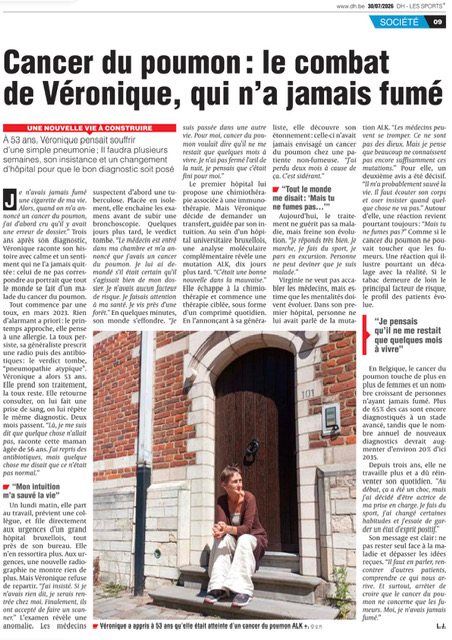
Caption: article about Veronique’s story, published in La Dernière Heure.
Source: La Dernière Heure
Only after Veronique kept pressing and changed hospital was comprehensive molecular testing carried out. It found an ALK alteration. Thanks to this information she was able to receive a targeted treatment aimed specifically at this change in the tumour.
Preconceptions around lung cancer
Lung cancer is still often automatically linked to smoking. Although smoking is an important risk factor, it does not tell the whole story. People who have never smoked can develop lung cancer too.
This persistent association can mean that symptoms are taken less seriously. Patients also sometimes face misunderstanding, feelings of guilt, or the assumption that they brought the illness on themselves.
Every patient with lung cancer deserves the same support, attention and access to appropriate diagnosis and treatment, regardless of smoking history.
Why biomarker testing matters so much
Lung cancer is not a single disease. Tumours can contain different genetic or molecular changes that affect which treatments are possible.
Comprehensive biomarker testing can show, for example, whether there is an ALK alteration or another treatable change. Without this analysis, important information can go unnoticed. That carries the risk that a patient does not gain access to a treatment that specifically fits their tumour.
When the disease starts growing again after an earlier treatment, new molecular testing can also be important. The characteristics of the tumour can change, and a new resistance mutation can arise.
Keep asking questions
Veronique’s story shows how important it is that patients are well informed and involved in decisions about their treatment.
Important questions to ask your doctor include:
- Has my tumour been comprehensively tested for biomarkers?
- Which molecular alterations were found?
- Which treatment options fit these results?
Patients should not have to fight for appropriate diagnostics themselves. Even so, it can help to ask questions, to request clear explanations, and to consider a second opinion if needed.
Read more on our website about ALK-positive lung cancer, biomarker testing and support for patients and their families.