
If you (or someone you care about) has ALK-positive lung cancer, sooner or later a moment comes when somebody says “clinical trial”. And then it starts: Is that something for later? Is it risky? Will I only get tests?
According to the National Cancer Institute, a clinical trial is usually not a leap in the dark, but a step-by-step way of testing new treatments safely and fairly, so that they can eventually become available to patients.
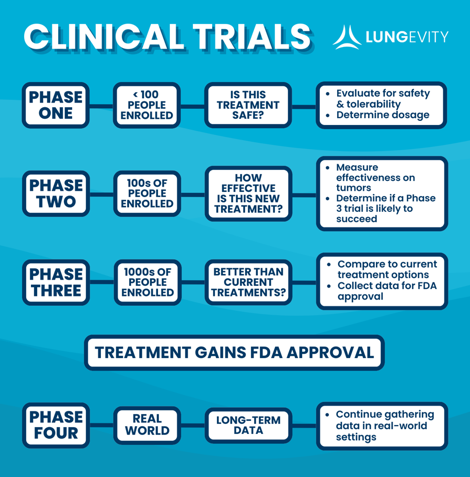
LUNGevity. (2024, 13 August). Understanding Clinical Trials: Why Are They Important for Drug Development? Image. https://www.lungevity.org/blogs/understanding-clinical-trials-why-are-they-important-for-drug-development
How does a new medicine come about?
New treatments do not appear out of nowhere. It often starts on a very small scale:
- First, researchers test substances in the laboratory: do they do anything against cancer cells?
- Then come preclinical tests, often using models such as mice, to see whether the effect holds up outside the dish.
- Only once that shows sufficient promise does the step to research in people follow: the clinical trial.
Those intermediate steps exist precisely to avoid something reaching people too quickly without solid preparation.
“Will I get tests, or will I get a treatment?”
This is a really important misunderstanding.
In many clinical trials, the point is a treatment.
What often comes with it are extra checks (blood samples, scans, questionnaires, sometimes ECGs) so that the research team can measure very precisely:
- is this working well?
- what side effects are there?
- who does it work best for?
So you are not doing “only tests”. Those extra checks are mainly there to keep a close eye on your safety and on what is being learned about the treatment.
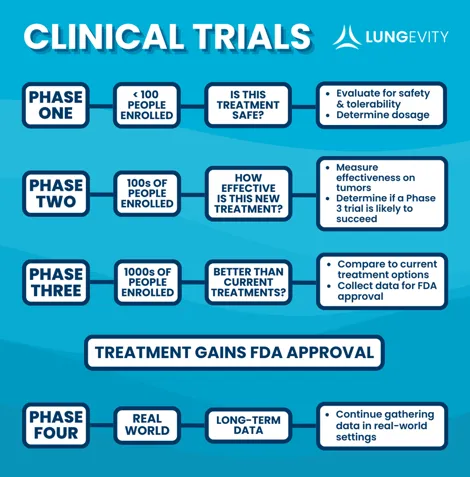
The 4 phases
Clinical trials usually run in phases. That sounds technical, but it is logically structured:
Phase 1 – Safety and dose
A small group of people. Researchers work out what a safe dose is and which side effects may occur.
Phase 2 – Does it work?
Researchers look at whether the treatment really has an effect (for example whether a tumour can shrink) and continue monitoring side effects.
Phase 3 – Comparison with the current standard
A larger study, often comparing against the current standard treatment. Depending on the country and procedures, this kind of result can help determine whether a treatment is officially approved.
Phase 4 – Long term, in real life
Even after a medicine reaches the market, follow-up can continue: how does it perform in the long run, in everyday practice? Rare or late effects sometimes only emerge at this point.
Why is this relevant in ALK+?
In ALK+ lung cancer, treatments are evolving quickly. Clinical trials are one of the ways that progress becomes concrete: they help discover what works better, for whom, and at which moment.
And even though a clinical trial is not always the right step for everyone, it can help enormously to understand what it is, so that the word alone does not alarm you.
7 questions to take to your next appointment
- Which phase is this study in, and what does that mean?
- What is the aim: safety, effectiveness, comparison with standard care?
- What are the possible benefits, and what do we not yet know?
- Which extra appointments or investigations does it involve?
- How demanding is it practically (travel, time, frequency)?
- Which side effects are expected, and how are they monitored?
- If I join: can I stop later, and what are the options then?
In closing: you do not have to decide this alone. A clinical trial is not an obligation, but an option. Take your time, ask questions, and let yourself be guided step by step with those close to you beside you.